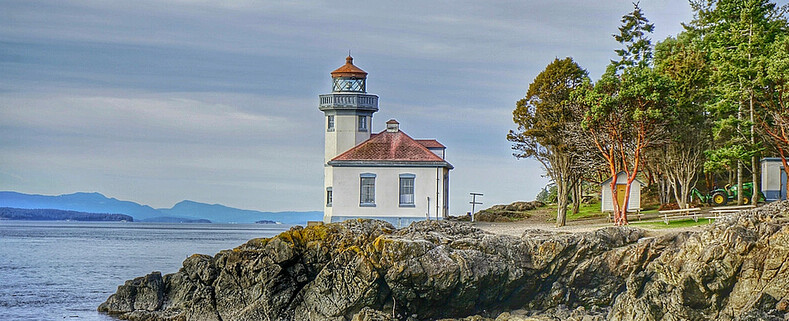
Lime Kiln Lighthouse

Lime Kiln Lighthouse on the west side of San Juan Island, Washington

Lime Kiln Lighthouse on the west side of San Juan Island, Washington

Lime Kiln Lighthouse on the west side of San Juan Island, Washington

Lime Kiln Lighthouse on the west side of San Juan Island, Washington

Lime Kiln Lighthouse on the west side of San Juan Island, Washington

Monday, January 16, 2012

No. 19 Saint Edwards State Park- Kenmore, Washington

Park overview:
Saint Edward State Park is a 316-acre day-use park with 3,000 feet of freshwater shoreline on Lake Washington. Once a Catholic seminary, the park's rich history reflects in its grounds and architecture. Walks along the undeveloped lakeshore are peaceful and give the visitor many opportunities for nature study.

Park hours/updates:

The park is open year round for day use only.

Summer: 8 a.m. to dusk.
Winter: 8 a.m. to dusk.


Requires a Discover Pass $10 a day $30 a year

Abandoned St. Edwards Seminary


Driving Directions
Located at the north end of Lake Washington in Kenmore, Wash. in King County.


Park address:
14445 Juanita Drive NE
Kenmore, WA 98028

From I-405 northbound:
Take exit #20-A (116th St. N.E.) and turn west (left). Travel 4.5 miles. (At 98th Ave., the road name changes to Juanita Dr.) Park entrance is on left.

From I-405 southbound:
Exit at Hwy. 522 (exit #23-B). Drive through Bothell to Kenmore. Turn left at 68th Ave. (68th turns into Juanita Dr.) Park is 1.5 miles on the right.

From I-5:
Take exit #175 (145th St.) and travel east to Bothell Way. Turn left. Travel north to 68th Ave. in Kenmore. (68th turns into Juanita Dr). Park is 1.5 miles on the right.

Stairway to Heaven?

Seminary trail, Saint Edwatds Park

Sunday, December 18, 2011

No. 18 Viewing Bald Eagles in Rockport, Washington


Bald eagles were officially declared an endangered species in 1967 in all areas of the United States south of the 40th parallel, under a law that preceded the Endangered Species Act of 1973. Federal and state government agencies, along with private organizations, successfully sought to alert the public about the eagle's plight and to protect its habitat. The 1972 ban on DDT has enabled eagles and other birds of prey to once again begin producing young. Unfortunately, recent extensive human use within preferred eagle habitats has resulted in disturbance and reproductive failure and abandonment of important areas.

Copyright Puget Exposure Photography


In 1994, the bald eagle was reclassified from "endangered" to "threatened" in the lower 48 states. There are currently about 4,500 nesting pairs and 20,000 total eagles in the lower 48 states. Although they have made an encouraging comeback, only public awareness of their situation, strict enforcement of protective laws, preservation of their habitat and support for environmental conservation programs can ensure a successful future for our national symbol.

Bald Eagles are also known as "baseballs" by experienced eagle watchers because from a distance that's what the eagle's white head looks like. It's amazing how an experienced eagle watcher can spot eagles from a distance. When searching for Bald Eagles look for the white "baseballs" in the trees along the river. Eagles can also be spotted taking advantage of the tows churning up stunned fish as they move up and down the river, riding chunks of ice, or kettling (soaring) the thermals in the afternoons.

Copyright Puget Exposure Photography

The 8,000-acre Skagit River Bald Eagle Natural Area is dedicated to habitat protection, conservation and educational efforts. This special area is an example of the Forest Service working with the Washington Department of Fish & Wildlife, The Nature Conservancy and other partners to conserve natural resources along the river.
Bald eagles are seen from late December through early February. During this period the Eagle Watchers Program, sponsored by the Forest Service and North Cascades Institute, provides hosts at designated sites along the river who assist with viewing these magnificent birds. You can also learn more at the annual  Upper Skagit Bald Eagle Festival or at the Skagit River Interpretive Center.

TIPS FOR HEADING OUT AND SPOTTING BALD EAGLES

1. DO plan on arriving early. Bald eagles are most active in the early morning hours. The best time for eagle watching is from sunrise to 11 am when eagles feed along the area’s rivers. In the afternoons they may be seen catching updrafts and soaring ("kettling") overhead. They leave the river in late afternoon to congregate in night roosts in sheltered timber areas nearby.
2. DO keep noises low and movements slow. Winter is a difficult time for eagles. They need to conserve energy to keep warm and flying burns up energy. It is important that they are not startled or frightened into flight. DO obey all signs regarding Eagle Rest Areas.
3. DO call a Visitor’s Center to find out if eagles have been spotted and where they are most active. For the Skagit River region call 360-853-7626. or visit their website at Skagiteagle.org
4. DO check the weather. Eagles like clear, cold mornings. Eagles will roost on rainy days and will be found soaring on windy days. More eagles will be seen when the rivers are frozen than when the water is clear.
5. DO dress accordingly. Wear layers so you can shed your outer clothing as the day heats up. Bring a hat or earmuffs for your head and gloves or mittens for your hands. Comfortable shoes are recommended.
6. DO bring binoculars or a spotting scope. If using a scope, a tripod is useful. Eagles fly amazingly close to the Great River Road, but even a small pair of binoculars can dramatically enhance your experience.
7. For photographs, keep the sun to your back or to your side and use a telephoto lens.
8. DO be patient. You are more likely to see eagles if you have time to spend.
9. DO observe proper eagle watching etiquette. Many people use the area’s single lane roads to get from here to there as promptly as possible. If you're admiring the view at twenty miles per hour, pull over when someone's behind you. DO respect private property. Use public areas along the river and be courteous to local land owners. DON'T  park on narrow highway shoulders. There are many parking areas along the area routes for parking. DO remember to buckle up. State law enforcement officers vigorously enforce the Click It or Ticket program.
10. The bald eagle is protected by a number of state and federal laws, each with stiff penalties. For example, the Eagle Protection Act, which protects bald and golden eagles, combined with the Criminal Fines Improvement Act of 1987, can cause violators to spend two years in jail or be fined up to $10,000 on a misdemeanor charge.  It is illegal to pursue, harm, harass, take or attempt to take, possess, sell, purchase or transport either eagles, eagle pans or their eggs without a permit. If you find a feather, look at it, take a picture, but do not pick it up.


Puget Exposure Photography provides this photo for the public to view. Media requiring a high-resolution version of this or a similar photo for publication should contact me. Users may not manipulate or use this photo in commercial materials, advertisements, emails, products, or promotions without licensed permission. Please do not use my images on blogs or websites without my permission. Contact me if you would like to license and image. Thank you.


Friday, October 21, 2011

No. 17 Planespotting at Paine Field Everett, Wa

Paine Field in Everett, WA is the home of Boeing’s largest factory and known best as the test field for the fresh off the line 777, 767, 748, and 787 frames. Daily arrivals included B1 First Flight 737 Next-Gen aircraft, coming in from Moses Lake, performing low missed approaches and touch and goes before they head to King County Airport south of Seattle. A few military p-3 Orions and helicopters can be scene in the pattern as well practicing touch and goes but those happen mainly during the summer time. Even if your not a bonafide avgeek or aviation enthusiast I think you will enjoy your time visiting Paine Field.

At the north end of the field you can stop by Boeing's own Future of Fight Museum, check out their exhibits, gift shop or hop on a bus and start your tour of the Boeing Plant. The visitor parking offers nice views of the flight line. You will be able to see the large Dreamlifter, a modified cargo 747-400 that carries parts for the new 787 Dreamliner parked directly across the runway. As you look south you can see 787s, 777, 747, and new 747-8 parked in their stalls. The sheer size of these transport aircraft make it easy for even a cellphone or point & shoot camera to make a decent image. Depending on delivery schedule you might even find yourself less than a football field away from 787 or 747 parked behind the museum.
On a clear day you can spot Mt. Baker off to the north and Mt. Rainier off to the south behind the control tower. The north parking lot brings you in close for aircraft departing Runway 34L when the wind is out of the north and to landing aircraft on Runway 16R when the wind is out of the south.


Boeing Manufacturing might be the largest tenant at Paine Field but jet aircraft aren't the only metal birds you see. There are two privately owned vintage warbird museums located at the airport. Along the west side you have the Historic Flight Foundation which you can access from Mukilteo Speedway. Their collection includes P-51 Mustang, B-25 Mitchel and other aircraft in flying condition. On the eastside you have the Flight Heritage Collection. Both museums offer a rare chance to get up close and personal to vintage aircraft restored in detail and into flying condition. Throughout the summer the skies above Mukilteo are teaming with the sound of radial engines racing through the sky. If your planning on being in the Seattle area over the summer its definitely worth checking out their fly-day schedules and check out these metal birds fly again.

Monday, October 17, 2011

No.16 The Dalles, Oregon

Photo by Tedder

Maryhill Windmills in evening light Maryhill, Washington

Rowena Crest

Japanese Hollow RD Abandoned School House

Boyd Loop Abandoned Farm House

Red Tailed Hawk & Mt. Hood

Seeing eye 2 eye with Red Tailed Hawk


Gear Used:
 
lens rental Learn Photography Online with the Pros Save $10 Now #KTCJQ12  Receive a FREE GIFT from Think Tank Photo

Saturday, October 1, 2011

No. 15 Lake Sammamish State Park, Issaquah Washington

Distance from Seattle: 20 Miles
Travel Time: 30min

Lake Sammamish State Park is a 512-acre day-use park with 6,858 feet of waterfront on Lake Sammamish. The area around the lake was an important culture zone for local Indian tribes for centuries. The park provides deciduous forest and wetland vegetation for the enjoyment of visitors. A salmon-bearing creek and a great-blue-heron rookery are additional features.

Park hours/updates:
Summer: 6:30 a.m. to dusk.
Winter: 6:30 a.m. to dusk for the main park and boat launch.


Discover Pass LogoAnnual pass: $30
One-day pass: $10
(Transaction and dealer fees may apply)
A Discover Pass is required for motor-vehicle access to state parks and recreation lands managed by the Washington State Parks and Recreation Commission, the Washington Department of Fish and Wildlife and the Washington State Department of Natural Resources.

Exemptions: Your purchase of the Discover Pass supports recreation on state lands. However, the Discover Pass is not required if you are camping or renting overnight accommodations, for the duration of your stay at that state park. For additional exemptions and more information, please visit the Discover Pass website.
The entrance to Lake Sammamish State Park is located on the southerns end of the lake off of NW Sammamish Rd. This is a state park and as such you have to purcahse a daily pass or anual pass to park your vehicle inside the park. There are many trails and walk ways for you to wander. In the summer or when the weather is nice you can expect this park to be busy. Following the shoreline you can see many types of predatory birds hiding in the trees.  You will need to walk softly and keep calm if you wish to get up close to these birds. Plenty of ducks and herons can be seen daily. For best birding results it helps to know the weather and feeding habbits of the birds so you will have the best chance of seeing the in action. I have come across a deer or fox but there were signs (poop droppings) that they are around in numbers. To see a deer its probably best to be an early visitor just prior to dawn. 


Screen shot 2011-10-01 at 9.42.51 PM

Fisherman on the banks of Lake Sammamish State Park
Salmon Fisherman on the banks of Lake Sammamish

Morning Stretch- Lake Sammaish
Morning Stretch

Red Tail Hawk over Lake Sammamish
Red Tail Hawk

Panning along with a duck
Panning Duck

B&W Female Mallard reflection
Black & White Duck

Male Duck fly by
Buzzing the Fisherman